Why air pressure falls with altitude
Learn why atmospheric pressure falls with altitude, how an altimeter converts pressure into a reading, and why its setting and temperature matter in flight.
Atmospheric pressure falls as you climb because there is less weight of air above you. That relationship lets a pressure altimeter turn a pressure measurement into an altitude indication. But the reading depends on a reference setting and a standard atmosphere; it is not a direct measurement of height above terrain. 1, 2.
Keep the measured pressure separate from the reference setting. Changing either can change the reading.
Why atmospheric pressure decreases with altitude
Pressure is force per unit area. In an atmosphere approximately in vertical balance, pressure at a level supports the weight of the air column above it. Move upwards through that column and you leave some of its mass below you. Less weight remains overhead, so pressure is lower. 1.
Air pressure also acts in all directions. The column explains the vertical pressure difference; it does not mean air only pushes downwards.
Density describes something else: mass per unit volume. Pressure, density and temperature are related, but they are not interchangeable. At the same pressure, warmer dry air is less dense than colder dry air. A pressure reading alone therefore cannot tell you the density without temperature information. 1.
Equal climbs do not produce equal pressure drops
The pressure–altitude relationship is curved, not a straight line. The International Standard Atmosphere (ISA) defines a reference relationship between pressure, temperature and altitude. EASA’s altimetry guidance explicitly notes both this non-linearity and the difference between ISA and the real atmosphere. 3.
Here are model values, rounded to the nearest hectopascal (hPa). They are not a weather forecast or observations from a particular flight. 1.
| ISA altitude | Approximate pressure |
|---|---|
| Sea level | 1013 hPa |
| 5,000 ft | 843 hPa |
| 10,000 ft | 697 hPa |
| 15,000 ft | 572 hPa |
| 20,000 ft | 466 hPa |
The first 5,000 ft gives a pressure drop of about 170 hPa. The same climb from 15,000 to 20,000 ft gives a drop of about 106 hPa. Equal height intervals do not remove equal amounts of air mass from the column overhead.
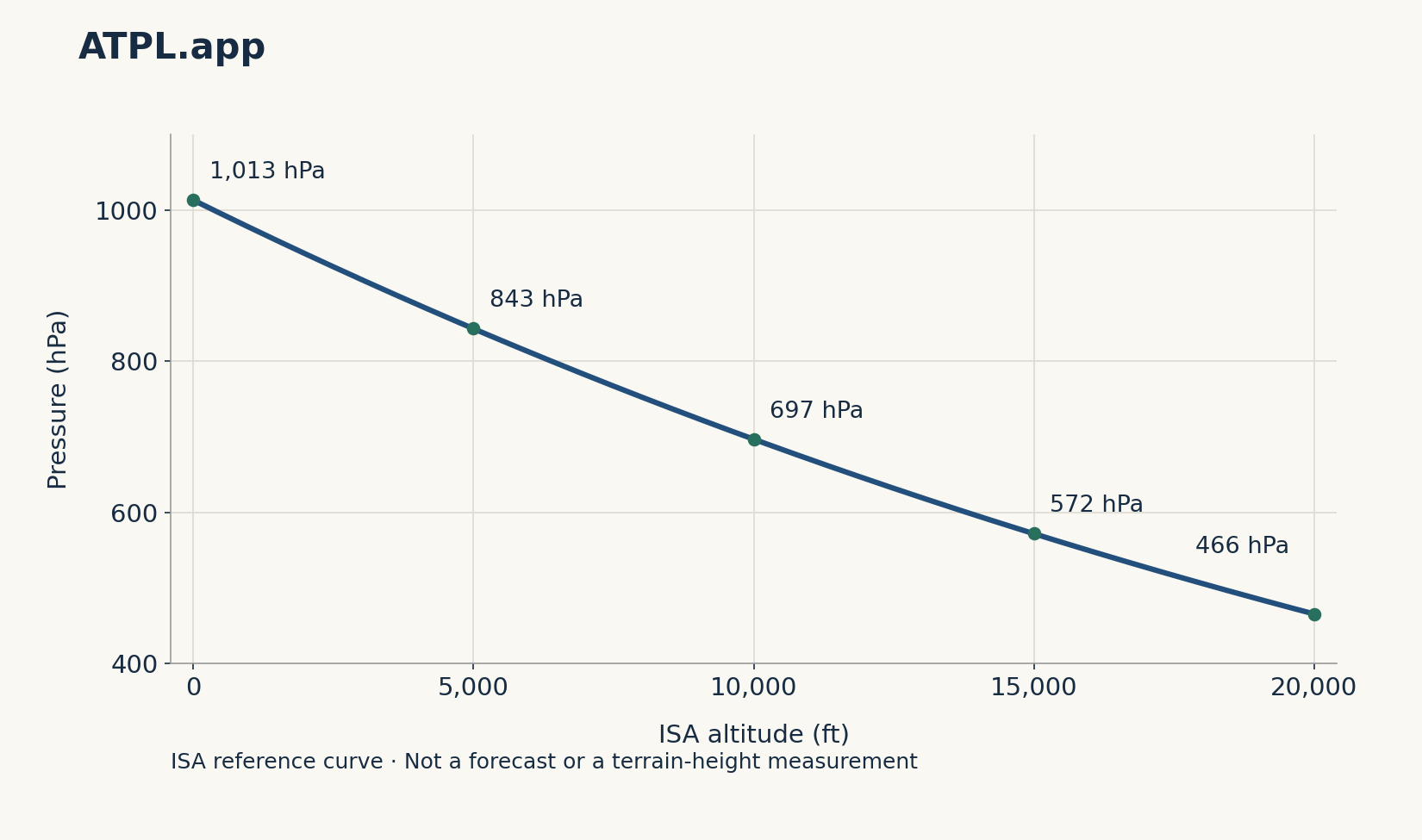
Original plot calculated from the ISA troposphere model. The curve shows reference values, not the pressure profile on every day.
A pressure-to-height shortcut that works near sea level will not give the same accuracy higher up.
How a pressure altimeter turns pressure into a reading
A pressure altimeter senses static pressure and uses a calibrated pressure–altitude relationship. Its sub-scale setting selects the pressure reference for the indication. Lower sensed pressure gives a higher indicated altitude if that setting stays unchanged. 2.
The settings below change the reference, not the aircraft’s physical position:
| Setting | What the indication refers to |
|---|---|
| QNH | Altitude above mean sea level; at the aerodrome supplying it, the altimeter should indicate the known elevation on the ground |
| QFE | Height above the specified aerodrome or runway reference datum; it should indicate zero at that datum |
| Standard pressure | Pressure altitude, used to express flight levels |
These distinctions are described in the UK CAA’s Skyway Code. QFE does not give clearance above every hill or valley beneath the aircraft: its reference is the specified datum, not the changing terrain. 4.
The exact ISA sea-level reference pressure is 1013.25 hPa; guidance also writes the standard setting as 1013 or 1013.2 hPa. A standard setting gives a pressure reference, not a guarantee of geometric altitude above sea level. 3.
Change the setting without changing height
For an original teaching example, keep the aircraft stationary near sea level and hold the sensed pressure constant. Increase the altimeter sub-scale setting from 1000 to 1010 hPa.
The indicated altitude increases. The aircraft has not climbed.
Using the Skyway Code’s near-sea-level approximation of 27 ft per hPa, the indication rises by about 10 × 27 = 270 ft. This is an approximate setting effect, not a universal pressure gradient. 4.
If the selected QNH is too high, the altimeter overreads relative to the correct setting: considering the setting error alone, the aircraft is lower than the indication suggests. Do not confuse that with increasing the aircraft’s height. ICAO’s altimeter-setting bulletin illustrates this error direction. 2.
Correct QNH does not remove temperature error
QNH establishes the pressure reference. It does not make the whole air column match ISA temperature.
In a colder-than-standard column, the vertical spacing between pressure levels is smaller. Above the altimeter-setting source, true height can therefore be less than indicated height even with the correct QNH. The discrepancy grows with height above that source. ICAO’s cold-temperature bulletin explains why a pressure-based indication can overstate terrain clearance in these conditions. 5.
Check the pressure reference and the temperature effect separately. Correct QNH can coexist with an overreading caused by a cold air column. Actual setting procedures and temperature corrections depend on the applicable flight information and aircraft guidance; this example explains the underlying relationship.
Check your understanding
- An aircraft climbs from sea level to 5,000 ft, then another 5,000 ft in ISA. Are the two pressure drops equal?
- At fixed sensed pressure, you increase the altimeter setting. Does the indication rise or fall?
- With QFE set, does the indication show height above whatever terrain is directly below?
Answers: No. The first drop is about 170 hPa; the next is about 146 hPa, using the rounded table. Increasing the setting raises the indication without moving the aircraft. QFE refers to a specified datum, so the indication does not follow the terrain underneath you.
References
-
UK Ministry of Defence, AP3456, Volume 10: Meteorology: chapter 10-1, May 2017, ISA table p. 6; atmospheric pressure pp. 7–8; pressure–height approximation p. 9; density relationships p. 11.
-
ICAO EUR OPS Bulletin 2023_001, 27 July 2023: section 2.2, calibration and reference settings; sections 3 and 4, setting-error effects. Used for the measurement principle, not approach procedures.
-
EASA, Easy Access Rules for ATM/ANS, March 2025 revision: GM1 ATS.TR.130(b), paragraphs (b)(2) and (c)(1)–(4), ISA calibration, non-linearity and standard pressure.
-
UK CAA, The Skyway Code, CAP 1535, November 2023: p. 91, pressure settings and approximate near-sea-level height sensitivity. Used for the reference distinctions, not a complete setting-procedure guide.
-
ICAO EUR OPS Bulletin 2015_001, 15 January 2015: p. 2, non-standard temperature and true altitude. Historical guidance used for the stable physical relationship, not current operational instructions.