How density altitude affects aircraft performance
Understand density altitude, how it differs from pressure altitude, and why a hotter day changes aircraft performance. Work through a clear two-day example.
Density altitude is the altitude in the International Standard Atmosphere (ISA) with the same air density as the air at your location. It puts density on an altitude scale; it does not measure your height above the ground. 1, 2.
An aerodrome with a density altitude of 5,400 ft has air corresponding to that density level in ISA. Its elevation stays the same, but the air density can change from day to day.
Density altitude is different from elevation and pressure altitude
ISA assigns a reference pressure, temperature, and density to each altitude. It assumes dry air. Actual conditions can differ from that reference, which is why the altitude values below need to be kept separate. 4.
| Quantity | What it describes | What changes it? |
|---|---|---|
| Aerodrome elevation | The aerodrome’s altitude above mean sea level | It is not changed by the day’s weather |
| Pressure altitude | The ISA altitude corresponding to the local atmospheric pressure | Local pressure |
| Density altitude | The ISA altitude corresponding to the air density | Pressure, temperature, and water-vapour content |
Pressure altitude is the altitude a pressure altimeter indicates with the standard 1013.25 hPa setting. To estimate density altitude, correct pressure altitude for temperature above or below ISA at that level. This is the practical relationship described in UK CAA performance guidance. 3.
That usual pressure-and-temperature calculation assumes dry air. Water vapour also affects actual density; it needs separate consideration when using a method or performance chart that specifies it.
How pressure, temperature, and humidity change air density
Higher density altitude means lower air density. Think of density as the mass of air in a given volume. In ISA, density decreases as altitude increases, so a lower density corresponds to a higher reference altitude. 4.
- Lower pressure, with temperature and air composition unchanged, means lower density and higher density altitude.
- Higher temperature, at the same pressure and composition, means lower density and higher density altitude.
- More water vapour, at the same total pressure and temperature, reduces density. Water-vapour molecules are lighter than the average molecules in dry air. 4.
The shortcut below uses pressure altitude and temperature. It leaves out water vapour, so it is a dry-air estimate.
Two days at the same aerodrome
Suppose the pressure altitude is 3,000 ft on both days. The aerodrome is the same, and we use a dry-air approximation to isolate the temperature effect.
At this pressure altitude, ISA temperature is approximately +9°C: start with +15°C at sea level and subtract roughly 2°C per 1,000 ft. Compare a day at +9°C with one at +29°C. 4.
| Hypothetical conditions | Day A | Day B |
|---|---|---|
| Pressure altitude | 3,000 ft | 3,000 ft |
| Outside air temperature | +9°C | +29°C |
| Temperature above ISA at that pressure altitude | 0°C | +20°C |
| Approximate density altitude | 3,000 ft | 5,400 ft |
Pressure altitude stays at 3,000 ft. On Day B, the air is 20°C warmer than ISA at that level, and the estimated density altitude rises by 2,400 ft.
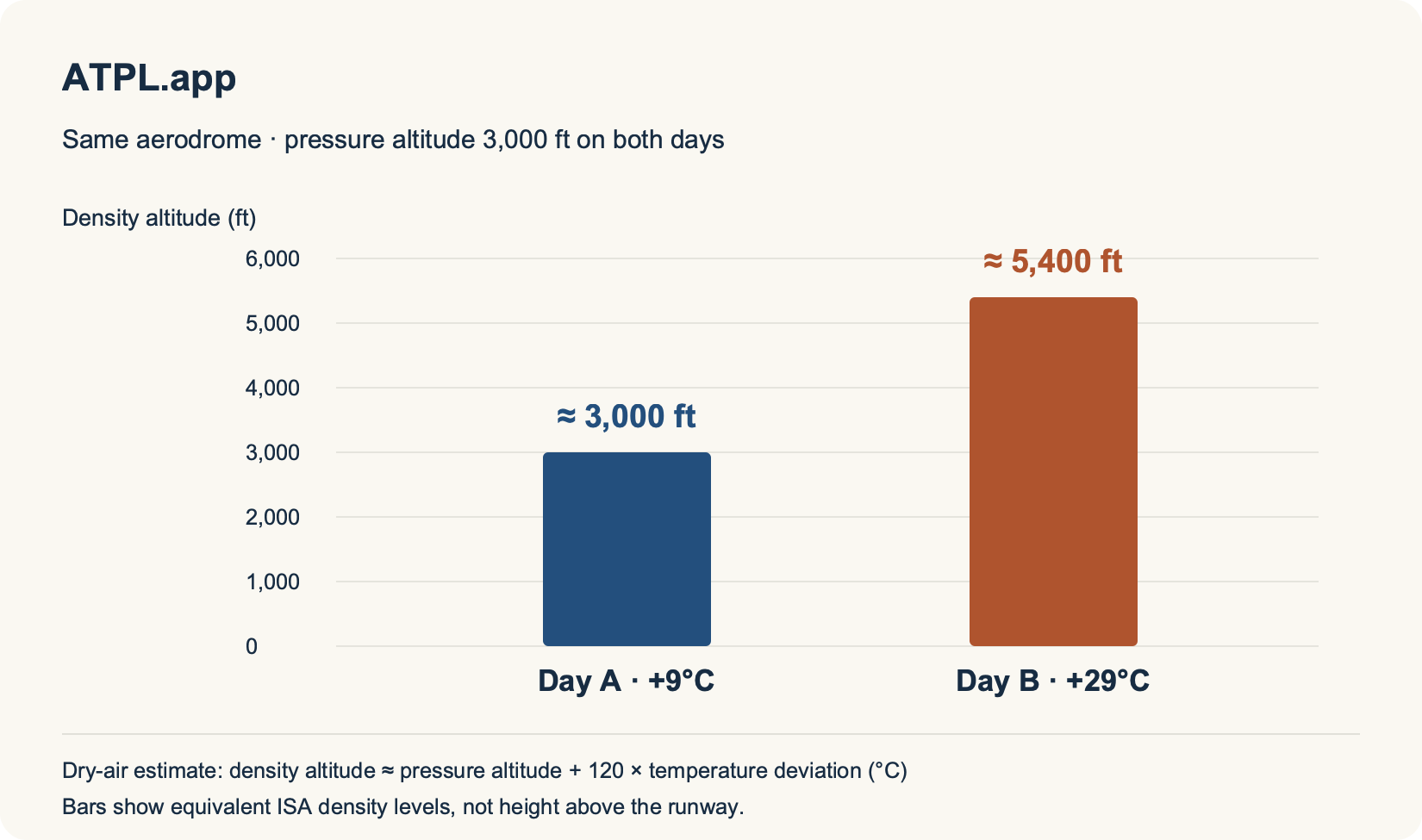
Hypothetical dry-air example. Both values use the same approximation; the aerodrome’s elevation is unchanged.
First find the temperature deviation: outside air temperature minus ISA temperature at the pressure altitude. The common low-altitude estimate is:
Density altitude (ft) ≈ pressure altitude (ft) + 120 × temperature deviation (°C)
The factor is approximately 120 ft per °C of temperature deviation. For Day B, the estimate is 3,000 + 120 × (29 − 9) = 5,400 ft. EASA illustrates the same approximate sensitivity as +10°C giving about +1,200 ft; the UK MOD meteorology manual gives the 120 ft/°C relationship. 2, 4.
Use ISA temperature at the pressure altitude. Comparing every outside temperature with +15°C would give the wrong deviation away from sea-level pressure altitude.
The shortcut estimates a density level. It does not calculate take-off distance or climb rate.
What a high density altitude means for performance
Lower air density affects both aerodynamic forces and the powerplant. At the same true airspeed and aerodynamic condition, a wing produces less lift in less-dense air. Normally aspirated piston engines also have less air mass available and can produce less power. The effect on a particular aircraft depends on its engine, configuration, and operating conditions. 6, 2, 4.
With other relevant conditions held comparable, an aeroplane generally needs more take-off distance and has less climb performance at high density altitude. The size of the change comes from its performance data. 3, 5.
Check the inputs in the Aircraft Flight Manual (AFM) or Pilot’s Operating Handbook (POH). Many charts use pressure altitude and temperature separately. Substituting density altitude for the requested pressure altitude can count the temperature effect twice. 3, 5.
Check your understanding
Return to the two-day example. Pressure altitude stays at 3,000 ft, but the temperature rises from +9°C to +29°C.
- Has the aerodrome’s elevation changed?
- Which day has the less-dense air?
- If a performance chart asks for pressure altitude and temperature, which values belong in it on Day B?
Answer: The aerodrome’s elevation is unchanged. Day B has the less-dense air and higher approximate density altitude.
The chart asks for 3,000 ft pressure altitude and +29°C. Enter those two values; the temperature input already accounts for the hotter conditions.
References
-
ICAO, Environmental Report 2010, chapter 6: density-altitude definition, printed p. 194, reference note 1.
-
EASA, Sunny Swift: Density altitude, issue 13, June 2019: definition, temperature sensitivity, and performance-chart inputs.
-
UK CAA, Safety Sense 09: Weight, Balance and Performance, August 2024: pressure/density altitude and performance charts, pp. 13–14.
-
UK Ministry of Defence, AP3456, Volume 10: Meteorology, chapter 10-1: ISA, p. 6; density-altitude estimate, p. 10; density relationships, p. 11. May 2017.
-
UK CAA, Safety Sense 35: Mountain Flying Safety, November 2024: aircraft performance and chart references, p. 9.
-
EASA/EHEST, Helicopter Performance, HE12: general air-density definition and effects on engines, section 3.2, p. 11.