Calculating wind correction angle
Calculate wind correction angle from course, wind and true airspeed. Follow worked examples, check the correction direction and understand the method’s limits.
Wind correction angle (WCA) is the angle you apply to a desired course to find a heading that will maintain that track in wind. A wind from the left needs a correction to the left; a wind from the right needs a correction to the right. Its size depends on the crosswind component and true airspeed. 1.
Drift describes what happens with the heading you are flying: it is the angle from heading to actual track. WCA tells you how far to offset the heading from the course you want. Once track matches course, those two angles have equal magnitudes and opposite senses. Drift observed before correcting need not have that same magnitude. 1.
Set the references before calculating
The calculation uses desired course, wind direction and speed, and true airspeed (TAS): speed through the air. Groundspeed is speed over the ground. Use the same speed units throughout; here, knots (kt) mean nautical miles per hour.
Wind direction says where the wind comes from. Wind from 270° blows towards 090°. Course, wind direction and heading must share a north reference: all true, or all magnetic after consistent conversion. A WCA is unchanged by that common rotation. Do not assume every wind report uses true north. 2.
Assume a short, straight, level leg without sideslip, so air velocity follows heading. Wind, TAS and desired-track direction stay constant. The examples below are invented teaching scenarios, and all directions are true (°T).
Wind correction angle formula
The aircraft moves through the air while the air moves over the ground. Adding those two movements gives the aircraft’s movement over the ground. Each has a speed and a direction, so we represent them as velocity vectors.
To keep the desired track, the aircraft’s sideways motion through the air must cancel the wind’s sideways motion over the ground. 2.
Use C for desired course, D for wind-FROM direction, W for wind speed and V for TAS. The wind angle is D − C. Set your calculator to degrees.
| Quantity | Formula | Meaning of the sign |
|---|---|---|
| Signed crosswind X | W × sin(D − C) | Positive: wind from the right; negative: from the left |
| Headwind component H | W × cos(D − C) | Positive: headwind; negative: tailwind |
| Correction A | arcsin(X / V) | Positive: correct right; negative: correct left |
| Heading | C + A | Bring the result into 000° to less than 360° |
| Along-track groundspeed G | V × cos(A) − H | Must be positive to progress along the desired track |
Splitting wind into components separates its effect across a direction from its effect along it. The CAA’s component chart uses a runway as that reference; here we use the desired track. 3.
With right positive, the wind actually moves the aircraft sideways at −X. The air velocity contributes V × sin(A) sideways. Setting their sum to zero gives V × sin(A) = X, hence the arcsine formula. “Arcsin”, also written sin⁻¹, means inverse sine, not 1 divided by sine.
Use the arcsine answer between −90° and +90°. This gives the heading with the greatest forward air component. The equations are exact within the stated model, provided the feasibility checks below pass.
Worked example: wind from the west
Desired course is 000°T, wind from 270°T at 20 kt, and TAS 100 kt. North is up; west is left. The wind moves the air east, so the correction must be left of north.
- Crosswind: X = 20 × sin(270° − 000°) = −20 kt.
- Correction: A = arcsin(−20 / 100) = −11.5°, rounded.
- Heading: 000° − 11.5° = 348.5°T, after wrapping through north.
- Headwind: H = 20 × cos(270°) = 0 kt.
- Groundspeed: G = 100 × cos(A) = 98.0 kt, using the unrounded A.
The corrected air velocity contains 20 kt west and about 98.0 kt north. Add the wind’s 20 kt east: the sideways components cancel and the resultant points north.
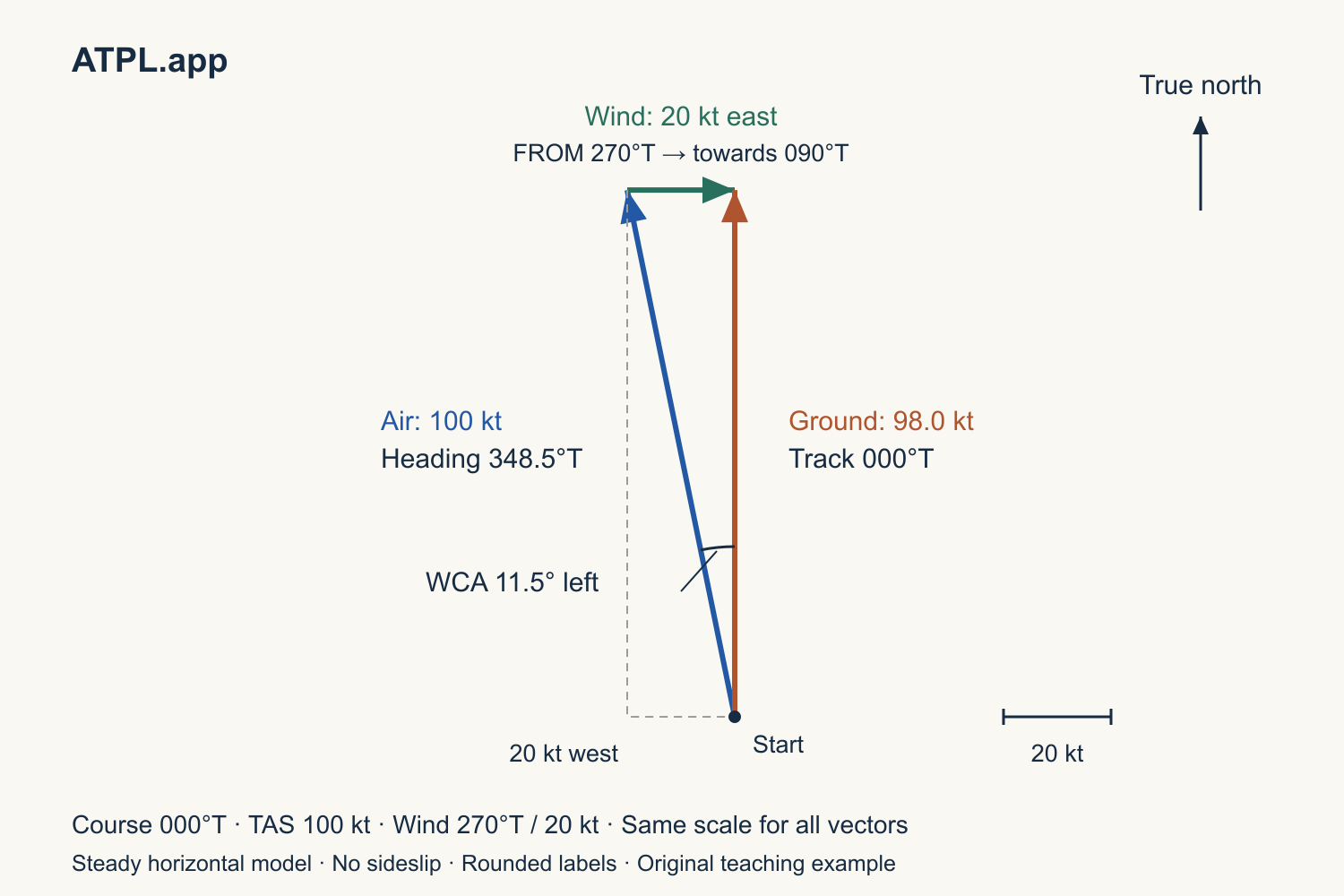
Plan view, north up. All three velocity arrows use the same scale. The wind arrow starts at the air arrow’s tip; the ground arrow joins the start to the final tip. Values shown are rounded.
Even with no headwind component, groundspeed is slightly below TAS: part of the air velocity is directed across the desired track.
If heading were instead held at 000°T, the resulting drift would be 11.3° right. That is arctan(20/100), rather than arcsin(20/100). Turning changes the triangle, which is why the uncorrected drift and required correction are not exactly equal.
A second example with a headwind component
Use course 060°T, wind from 030°T at 30 kt, and TAS 120 kt. The wind comes from 30° left of the desired course and has a headwind component.
| Step | Calculation | Result |
|---|---|---|
| Crosswind | 30 × sin(030° − 060°) | −15.0 kt |
| Headwind | 30 × cos(030° − 060°) | 26.0 kt |
| WCA | arcsin(−15 / 120) | −7.2°, left |
| Heading | 060° + A | 052.8°T |
| Groundspeed | 120 × cos(A) − H | 93.1 kt |
Keep unrounded A and H until the final results. The air velocity contributes 15 kt left of course, cancelling the wind’s 15 kt to the right. About 119.1 kt of air velocity remains along the course. Subtract the headwind to get 93.1 kt over the ground. The heading lies towards the wind-FROM direction, as expected.
The mental estimate and the limits
For a small correction, a mental estimate is A ≈ 60 × X / V, in degrees. Historical EASA learning material expresses it as crosswind divided by speed factor (TAS/60). 4.
This replaces arcsine with a small-angle approximation and rounds 57.3 degrees per radian to 60. For |X|/V up to 0.2 (|X| means the size of X, ignoring its plus or minus sign), the angle error is below 0.5° in this model. In the first example, it gives 12° left instead of 11.5°. Use the exact method for these worked answers; do not extend the estimate towards the feasibility limit.
Two checks determine whether the desired track is possible:
- |X| must not exceed V. The magnitude of crosswind cannot exceed the available sideways airspeed. Otherwise there is no real arcsine answer.
- G must be greater than zero. Cancelling crosswind does not guarantee forward ground progress. A direct 110 kt headwind with 100 kt TAS gives WCA zero but G = −10 kt: motion is backwards along the intended line.
At |X| = V, all air velocity is sideways; forward progress then needs a tailwind component. Total wind speed alone does not decide feasibility. A strong tailwind may still permit the track if its crosswind component can be cancelled.
The calculation gives a heading for a track direction from the present position. It does not rejoin a route already missed. Changing wind or TAS requires a new calculation. Rounding the heading also leaves a small residual track error.
Check your understanding
Course 090°T, wind from 120°T at 20 kt, TAS 100 kt. Which way should you correct, and what are the heading and groundspeed?
Answer: Wind is from the right, so correct right. X = +10 kt and H ≈ 17.3 kt. A = arcsin(10/100) ≈ +5.7°; heading ≈ 095.7°T. Using unrounded values gives groundspeed ≈ 82.2 kt. The air vector’s rightward component cancels the wind’s leftward component.
References
- FAA, Pilot’s Handbook of Aeronautical Knowledge, FAA-H-8083-25C, 2023, Chapter 16: Effect of Wind and terminology, pp. 16-8–16-10.
- UK Ministry of Defence, AP3456, Volume 9, chapter 9-4, revised July 2010: wind and vector addition, pp. 1–3; track and drift, pp. 5–6.
- UK CAA, The Skyway Code, CAP 1535, version 4, November 2023: Crosswind component, p. 154.
- EASA, Annex II to ED Decision 2016/008/R: wind triangle and mental calculations, pp. 356–358. Historical learning material, not a statement of current regulatory requirements.